Is the Bible Copyrighted? What You Can Freely Quote and Share (2026)
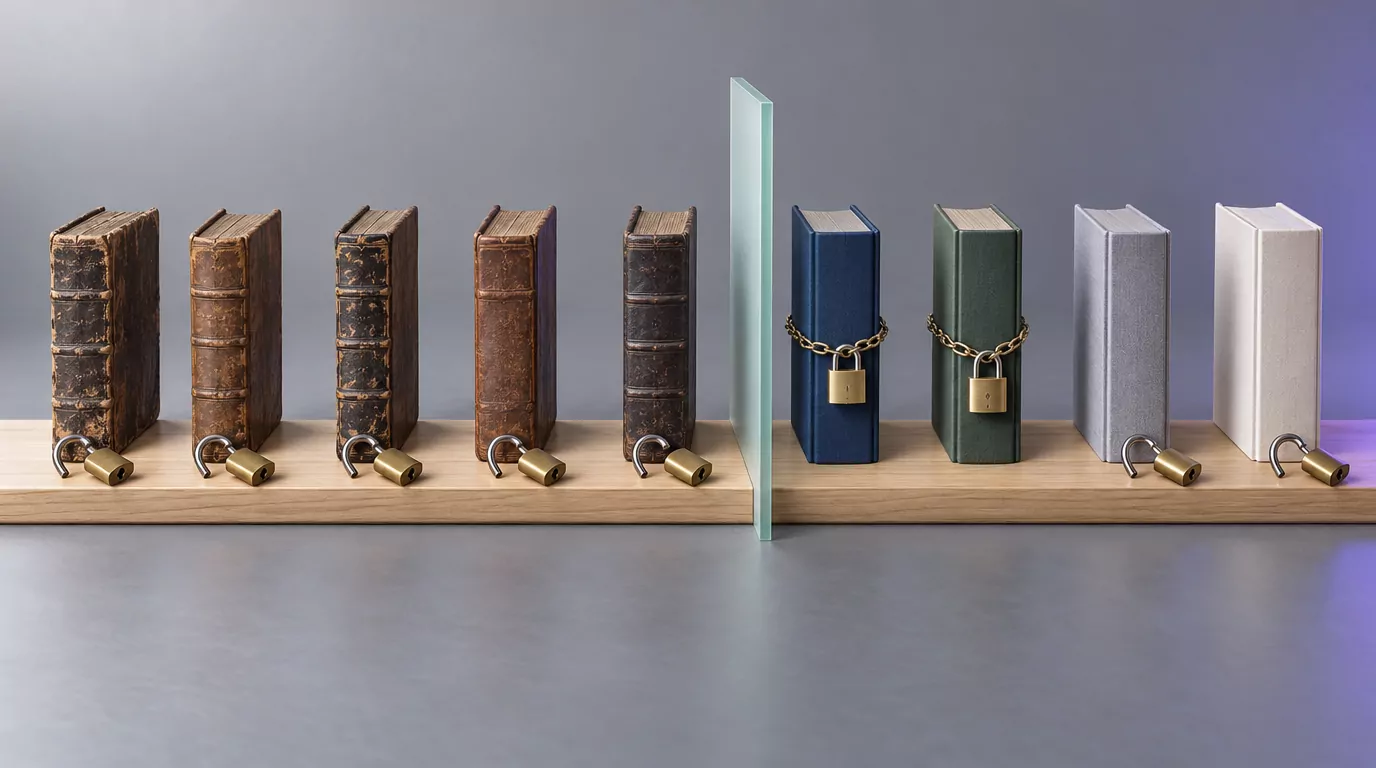
Is the Bible copyrighted? Partly: the Bible's original Hebrew, Aramaic and Greek texts are far too old for copyright, and so are older translations such as the King James Version (except in the UK) and the American Standard Version. Most modern translations, including the NIV, ESV, NLT and NKJV, are copyrighted, so quoting them follows each publisher's permission rules.
Copying a verse into a text or onto a slide is natural, and the rules depend on which version you copied. This guide shows what you can share and how to credit it.
It is general information, not legal advice. For a book, product or app, ask the publisher.
Is the Bible Copyrighted? The Short Answer
So who owns the copyright to the Bible? It depends on the layer: the ancient text, the translation or the extras around it.
The Ancient Texts Belong to No One
The books of the Bible were written in Hebrew, Aramaic and Greek many centuries before copyright law existed, so the ancient texts themselves are not anyone's property. For those ancient words, the answer to "is the Bible public domain?" is yes.
A modern printed edition of the Hebrew or Greek is new work, though. Its editors compare many old copies of the text, and that edition can carry its own rights, as the SBL Greek New Testament license shows.
Why Modern Translations Carry a Copyright
A translation is new work: a team chooses the English words, and copyright law protects that work. The Confraternity of Christian Doctrine, which owns the New American Bible, revised edition (NABRE), says its copyright protects the integrity of the text from changes made without permission. It adds that licensing royalties help fund Scripture scholarship.
Some Christians argue that Scripture should be shared freely, as Selling Jesus does. This guide takes no side. A copyright says nothing about accuracy either (see how translations compare for accuracy).
Study Notes, Maps and Charts Can Be Protected Too
The extras in a Bible edition can need their own permission. HarperCollins Christian Publishing says its rules for quoting without asking do not cover charts, maps, illustrations, footnotes, study notes and reference material from its study Bibles. The American Bible Society asks for written permission for such extras too.
The simple rule: copy the verse, not the study notes.
Public Domain Bible Translations
In the United States, works published in 1930 or earlier are now in the public domain. Works from 1930 entered it on January 1, 2026, says Duke's Center for the Study of the Public Domain. Some modern translators gave up copyright on purpose.
| Translation | Date | Status | Source |
|---|---|---|---|
| King James Version (KJV) | 1611 | Public domain in most countries. The UK is the exception. | Wikipedia |
| American Standard Version (ASV) | 1901 | Public domain in the US since January 1, 1957. | Wikipedia |
| Young's Literal Translation (YLT) | 1862 | Public domain. | Wikipedia |
| Douay-Rheims, Challoner revision | 1749, 1750, 1752 | Public domain. | Wikipedia |
| Darby Bible | 1890 (complete Bible) | Public domain in the US. | Wikipedia |
| Webster's Bible | 1833 | Public domain in the US. | Wikipedia |
| World English Bible (WEB) | Modern, based on the ASV | Public domain. The name is a trademark for faithful copies only. | worldenglish.bible |
| New Heart English Bible (NHEB) | Statement dated September 22, 2009 | Given to the public domain by its editors and translators. | CrossWire |
| Berean Standard Bible (BSB) | April 30, 2023 | Public domain. Changed texts are asked not to use the Berean name. | berean.bible |
Public domain means no permission or fee, but a label is still the honest thing to add.
Is the KJV Copyrighted?
In the United States and most other countries, no. In the United Kingdom, the right to print the KJV is a royal prerogative, and the Crown licenses publishers under letters patent.
In England, Wales and Northern Ireland the King's Printer is Cambridge University Press, which handles KJV permission requests. Scotland has its own licensing body, the Scottish Bible Board.
So who owns the copyright to the KJV Bible? In most places no one. For how a modern revision updates its language, see KJV vs NKJV.
Copyrighted Translations and Where to Check Permission
For most modern versions, the answer to "is the Bible copyrighted?" is yes. Each publisher posts its own rules, and they change (the ESV notice now names "ESV Text Edition: 2025"), so the figures below are as posted in October 2026.
| Translation | Holder named in its notice | Verses you may quote without asking (Oct 2026) | Where to check |
|---|---|---|---|
| NIV | Biblica, Inc., used with permission of Zondervan | 500 | HarperCollins Christian Publishing (outside the US and Canada, Biblica) |
| NKJV | Thomas Nelson | 500 | HarperCollins Christian Publishing |
| ESV | Crossway | 500 | Crossway |
| NLT | Tyndale House Publishers | See page | Tyndale |
| CSB | Holman Bible Publishers | 1,000 | CSB |
| NASB (and Amplified) | The Lockman Foundation | 1,000 | Lockman |
| GNT and CEV | American Bible Society | 500 | American Bible Society |
| NABRE | Confraternity of Christian Doctrine | See page | USCCB |
On the permission pages checked in October 2026, the limits for quoting without asking ran from 500 to 1,000 verses, each with further caps, so check the page for the version you quote.
So NIV Bible copyright permission starts with HarperCollins, and ESV copyright permission with Crossway. Still choosing? NLT vs KJV shows how a modern and an older text read.
What the Permission Pages Have in Common
- A cap on how much you may quote without asking.
- A cap on their share of your own work.
- No complete books, and often a cap on the share of any one book.
- A copyright notice in published work.
- Written permission for anything more.
Details differ. Crossway, which publishes the ESV (see ESV vs KJV), says the ESV may not be quoted in a publication released under a Creative Commons license, a rule that matters to some bloggers.
Everyday Situations: What You Can Share
Texting a Verse or Posting It on Social Media
Sending a verse to a friend, copying one into a journal and writing cards to memorize Bible verses are everyday personal uses. Add the reference and the version label.
Bible copyright rules for social media vary. Lockman says posts, blogs and emails may use (NASB) with the quotation, linked to Lockman.org when possible.
Church Bulletins, Slides and Group Handouts
Church media that is not sold gets simpler rules. Crossway says a full notice is not required in bulletins and posters, but (ESV) must follow the quotation, and Lockman allows (NASB) after quotations in bulletins and on slides. Leaders who print a whole chapter each week should read the publisher's page or use a public domain text.
Can I Put a Bible Verse on a Shirt and Sell It?
A public domain Bible such as the KJV (outside the UK), the WEB or the BSB needs no permission. With a copyrighted version, check first. HarperCollins Christian Publishing lists "Scripture on a product in which the verse stands alone, such as artwork, note cards, crafts, novelty products, and jewelry" among uses its gratis guidelines do not cover.
The American Bible Society says printing GNT or CEV verses on T-shirts to sell needs written permission or a licensing agreement, which may involve royalties or other fees. For designs and logos, ask the publisher or a lawyer.
Books, Blogs, Websites and Apps
Published work usually needs the full copyright notice, and a whole translation in an app is a licensing matter: the American Bible Society says the GNT or CEV in a Bible study app needs written permission. Because public domain texts need no license, they are a common choice for free Bible websites and apps.

How to Credit a Bible Verse
- Copy the words exactly, and mark a shortened quote as an excerpt.
- Add the reference, such as John 3:16-18.
- Add the version's initials in parentheses, such as (NHEB) or (KJV).
- In a book or on a website, add the publisher's full notice.
Here is one verse in two public domain versions.
"Your word is a lamp to my feet, and a light for my path."
Psalm 119:105 (NHEB)
"Thy word is a lamp unto my feet, and a light unto my path."
Psalm 119:105 (KJV)
Psalm 119 is a long poem arranged by the letters of the Hebrew alphabet, in which the psalmist speaks to God in praise of his word. Read it in the Psalm 119 chapter overview.
The two lines say the same thing in different English. The WEB reads exactly like the NHEB here, so only the label tells a reader which text you used. To compare more versions side by side, use the chart or the site's translation comparison.
Example: The Labels on BibleMate's Texts
The BibleMate web reader uses the New Heart English Bible and names it on each reading, as Day 1 shows. The NHEB is public domain, so text you copy from the reader can be shared with the label (NHEB). The site's verse collections use KJV wording, so add (KJV) when you share one.
The iPhone app uses the World English Bible, and text shared from it carries "(WEB) via BibleMate". In the app, copying and sharing past Day 1 need BibleMate Pro, and Android may differ.
Read and Share With a Clear Label
Today's step can stay small: read one passage and label any verse you share. BibleMate is on the App Store for iPhone and on Google Play for Android, free to download with optional in-app purchases (only Day 1 is open without BibleMate Pro).
Prefer your browser? The free web reader needs no account. Begin today, one day at a time.
Frequently Asked Questions
Which version of the Bible is copyright free?
The KJV (outside the UK), ASV, YLT, Douay-Rheims (Challoner revision), WEB, NHEB and BSB are public domain, and so are the Darby and Webster's Bibles in the US.
Who owns the copyright to the NKJV Bible?
Thomas Nelson, whose notice dates the copyright to 1982. Permission requests go through HarperCollins Christian Publishing.
Can you legally sell a Bible?
Publishers sell Bibles they own or license. The BSB's own site says publishers are free to produce and sell it, while a copyrighted version, or the KJV in the UK, needs a license. Anyone planning to sell a Bible product should ask the publisher first.
Is the NIV public domain?
No. Its notice names Biblica, Inc. (copyright 1973, 1978, 1984, 2011), used with permission of Zondervan. Compare it with an older text in KJV vs NIV.
Is the Catholic Bible copyrighted?
It depends on the translation. The NABRE, widely used by Catholics in the US, is owned by the Confraternity of Christian Doctrine. The older Douay-Rheims (Challoner revision) is public domain.